

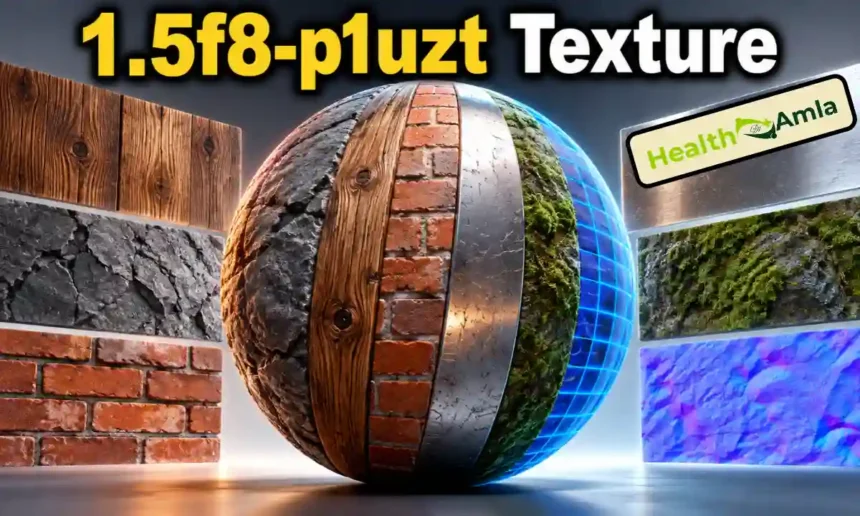
1.5f8-p1uzt texture is a strange technical keyword which may be used during searches in relation to digital graphics, 3D modeling, gaming, image rendering, textures and computer-generated visuals. The keyword is made of numbers, letters and hyphen and may refer to a particular format of texture, software-created texture or even digital asset identifier.
1.5f8-p1uzt is not among well-known texture formats like PNG, JPEG, TIFF, DDS, TGA and KTX2. The keyword may mean different things in different cases when used in relation to software, website, database, project and digital asset in question. It is important to understand the difference between texture format and texture name.
What Is 1.5f8-p1uzt Texture?
The term “1.5f8-p1uzt” seems to be a technical term rather than an image format that is universally known or accepted. Different applications for digital design, games, assets libraries, renderers, and other software have capabilities to create unique terms for every particular file.
Texture can hold information regarding the color, appearance, reflectivity, roughness, transparency, or depth of an object. What a particular texture does is defined by the file itself and its material properties, and not by the name given to it.
Hence, “1.5f8-p1uzt” cannot be assumed to be a new image format right away. It may refer to some specific asset, materials, internal term, or any other thing generated by software.
Is 1.5f8-p1uzt a Standard Texture Format?
There is no established definition for texture 1.5f8-p1uzt format. In general, all established textures have technical definitions, file extensions, software support, compression algorithms, and texture characteristics.
For instance, PNG is generally used for images and transparency, and DDS is generally related to graphics and game development. KTX2 is used for efficient transfer of GPU textures. The string 1.5f8-p1uzt does not give enough information to identify these parameters.
Why Does 1.5f8-p1uzt Look Like a Code?
In the modern world of computing, automatic generation of identifiers is common in digital programs. The identifiers enable computers to differentiate among millions of objects.
Instead of using meaningful names like wood-floor-dark.png to name textures, some software will give each texture a unique identifier. The identifiers may consist of letters, numbers, symbols, and even random characters.
The identification process is beneficial for computerized operations since the name is not made with the intention of being understandable.
What Is a Digital Texture?
Texture digital refers to an image or data source that describes the appearance of a surface. Texture is used extensively in the gaming industry, 3D rendering, animation, architecture, films, simulation, and digital artistry.
Using a texture, a simple 3D model can be given additional detail. For instance, a basic 3D wall structure may use a texture to provide the appearance of a wall constructed using bricks, concrete, painting, cracks, or dirt. There are various types of information in textures, depending on their application.
Types of Texture Maps
Modern 3D workflows commonly use multiple texture maps to create realistic materials.
Base Color Texture
The Base Color texture defines the primary colors that are visible on an object. It can include any pattern, picture, gradient, stain, or any other detail. For instance, if you have a wooden table, its Base Color will include all the colors of brown and wood grain.
Normal Texture
A standard map is one that gives the illusion of fine surface detail without necessarily increasing the surface geometry. This map makes surfaces appear scratched, grooved, pitted, or porous through interaction with light.
Roughness Texture
Roughness map determines how a surface reflects light. In most cases, a smooth surface tends to generate sharp reflections while a rough surface will scatter light more widely. This kind of texture is useful when designing materials such as plastic, wood, stone, glass, and paint surfaces.
Metallic Texture
The metallic map specifies which areas of an object have metallic behavior in the physically based rendering process. This map may come in handy when dealing with objects such as cars, machines, tools, jewelry, and electronics.
Height Texture
A height map stores information about apparent surface elevation. Depending on the rendering system, it may be used to create additional depth or displacement.
Ambient Occlusion Texture
Ambient occlusion information can help emphasize contact areas, corners, cavities, and recessed sections of a model. It can make objects appear more grounded and visually detailed.
1.5f8-p1uzt Texture in 3D Graphics
Textures are an essential part of 3D graphics because they allow artists to create detailed surfaces without modeling every tiny feature.
A 3D model without textures may look simple or artificial. Adding appropriate textures can make the same model appear like wood, metal, stone, leather, fabric, concrete, plastic, or another material.
If 1.5f8-p1uzt refers to a particular texture asset, its usefulness would depend on what type of texture data is actually contained in the associated file.
1.5f8-p1uzt Texture in Game Development
Game developers use textures extensively to create environments, characters, vehicles, buildings, weapons, terrain, objects, and user-interface elements.
A large game may contain thousands of individual texture assets. Managing these resources requires organized naming systems and asset identifiers.
An unfamiliar code such as 1.5f8-p1uzt could therefore potentially be associated with an individual resource within a larger game-development pipeline. However, the code alone cannot establish its specific purpose.
1.5f8-p1uzt and PBR Materials
Physical-Based Rendering, otherwise known as PBR, is a method of rendering aimed at generating realistic reactions to the lighting.
In most cases, PBR materials require the following texture data to be set up:
- Base Color
- Roughness
- Metallic
- Normal
- Ambient Occlusion
- Height/Displacement
Once these maps have been set up correctly, it will make the digital material react to lighting in a more realistic manner. Nevertheless, the name 1.5f8-p1uzt alone will not indicate whether an asset is made using the PBR rendering method.
Possible Uses of 1.5f8-p1uzt Texture
Given that 1.5f8-p1uzt is a texture or digital asset code, it can be used in several applications, such as:
- 3D modeling
- Game development
- Digital art
- Architectural visualization
- Animation
- Product visualization
- Virtual reality
- Augmented reality
- Simulation
- Computer-generated imagery
- Real-time rendering
The specific application will depend on the underlying asset.
How to Identify a 1.5f8-p1uzt Texture
If you encounter a file or asset labeled 1.5f8-p1uzt, the name alone should not be used to determine its format. First, check the complete filename and file extension. The extension may reveal whether the underlying file is PNG, JPEG, TGA, DDS, TIFF, EXR, KTX2, or another format.
Next, check the file properties, resolution, color channels, bit depth, and software associated with the file. The location of the asset can also provide useful information. A texture stored inside a game project, 3D modeling folder, cache directory, or material library may have a different purpose.
Important Properties of a Texture
When examining an unfamiliar texture, several properties are particularly important.
| Property | Meaning |
|---|---|
| Resolution | Determines the dimensions of the texture |
| File Format | Identifies how the texture is stored |
| Color Channels | Shows whether it contains RGB, RGBA, grayscale, or other data |
| Bit Depth | Determines the precision of stored information |
| Compression | Influences file size and visual quality |
| Alpha Channel | Provides transparency information |
| Texture Type | Identifies color, normal, roughness, metallic, or other data |
| Color Space | Determines how color information is interpreted |
| Mipmaps | Provide lower-resolution versions for efficient rendering |
Texture Resolution
Resolution refers to the number of pixels contained in a texture. Common resolutions include 512 × 512, 1024 × 1024, 2048 × 2048, and 4096 × 4096 pixels.
Higher-resolution textures can provide more visual detail, but they also require more storage and memory. For this reason, artists and developers generally choose a resolution appropriate for the size and importance of an object within the final scene.
Texture Compression
Compression is important for reducing the size of texture files and improving performance. Some compression methods are designed for general image storage, while others are optimized for graphics hardware and real-time rendering.
The appropriate compression method depends on the target platform, texture type, quality requirements, and rendering engine.
Texture Channels
A texture can contain different channels depending on its purpose. A standard color image may contain red, green, and blue channels. An RGBA texture adds an alpha channel that can store transparency information.
Some technical texture maps may use individual channels to store roughness, metallic information, masks, or other material properties. Understanding the channels is therefore important before editing or converting an unfamiliar texture.
Advantages of Digital Textures
Digital textures provide several important benefits in computer graphics.
Detailed Surface Appearance
Textures allow artists to create highly detailed surfaces without modeling every small feature.
Efficient Asset Creation
A texture can add visual complexity to a relatively simple 3D model.
Flexible Editing
Artists can modify textures without completely rebuilding the underlying model.
Realistic Materials
Multiple texture maps can reproduce complex material properties such as roughness, reflectivity, and surface irregularities.
Reusable Assets
A texture can sometimes be reused across multiple models or scenes, reducing production time.
Limitations of Textures
Textures also have limitations. High-resolution assets can consume significant memory and storage. Poorly optimized textures may increase loading times and reduce performance, particularly in real-time applications.
Textures also cannot always replace actual geometry. Large physical features such as deep holes, complex shapes, or major surface deformation may require modeling or displacement rather than simple texture information.
Common Mistakes With Unknown Texture Files
The Name Is Not the Format
A strange filename doesn’t mean that a new format was used for an image.
Manually Changing the File Extension
File extension change is not enough to convert a file. Conversion requires the use of appropriate software.
Ignoring the Color Space Setting
Incorrect setting of color space can lead to such problems as wrong brightness or other issues with the texture.
Choosing the Incorrect Type of Texture
A normal map shouldn’t be viewed as just a color picture. Every texture type has its own purpose.
Deleting the Unknown File
An unknown texture might be used in a project, material or scene. Deleting such a file without proper checking may lead to errors.
How to Optimize Texture Performance
Texture optimization is particularly crucial in video games and other applications that need real-time processing. The first thing to do would be to select the right resolution. Textures which are very high in resolution should only be used when their extra details are needed.
Compression can now be done depending on the particular platform you will be using. Mipmaps can also increase rendering efficiency through using smaller versions of the textures when they are far from the camera. Unnecessary textures should also be stripped from the game.
1.5f8-p1uzt Texture and Digital Asset Management
The creation of major artistic projects involves the creation of organizational structures for digital assets. Unique asset identifiers may be useful when it comes to the identification of textures, models, materials, animations, and other types of assets. The uniqueness of asset identifiers will avoid situations in which two assets get identical references inside the system.
In addition, unique identifiers will be useful when it comes to the management of assets by automated systems. Thus, an unknown texture identifier does not necessarily represent an issue.
1.5f8-p1uzt Texture vs Common Texture Formats
| Feature | 1.5f8-p1uzt | PNG | JPEG | DDS | KTX2 |
|---|---|---|---|---|---|
| Standard public format | Not established | Yes | Yes | Yes | Yes |
| Recognized extension | Not established | .png | .jpg/.jpeg | .dds | .ktx2 |
| Common graphics use | Unclear | Yes | Yes | Yes | Yes |
| Compression specification | Unknown | Established | Established | Established | Established |
| Texture-map support | Depends on asset | Yes | Limited | Yes | Yes |
| Exact meaning | Context dependent | Defined | Defined | Defined | Defined |
Is 1.5f8-p1uzt Safe to Use?
As far as the name denotes a usual digital item, the security of this element depends on the real file, not on the name. Users should use reliable sources to get assets, run scans on unknown downloads, and not launch unknown executables merely because they are named as textures.
An image or texture file is not like an executable application. That is why the checking of the real file extension is needed.
How to Work With an Unknown Texture
In case there is any file linked to the name 1.5f8-p1uzt, an easy process to follow is the following:
- Copy the file to create a copy.
- Determine the exact file name.
- Get the extension of the file.
- Get its resolution and file size.
- Get its texture type.
- Get the program that created the file.
- Get the number of times it is referred in other files.
- Open it using relevant software.
- Convert it when you know the format of the original file.
- Do not modify the original file.
Future of Texture Technology
As graphics get more intricate and real-time rendering gets more advanced, texture technology is still developing. The latest techniques involve the use of physical material, procedural texture generation, virtual texturing, GPU compression, high-resolution textures, and automation of asset management.
This is likely to generate more computer-generated asset naming and IDs. It will be vital for designers and programmers to know the difference between an ID and a file format.
Key Facts About 1.5f8-p1uzt Texture
| Question | Answer |
|---|---|
| What is 1.5f8-p1uzt? | An unusual texture-related technical term or identifier |
| Is it a recognized standard format? | No widely recognized standard is established under this name |
| Is it necessarily an image file? | No |
| Can it identify a digital asset? | It may |
| Can its exact format be determined from the name? | No |
| Is it automatically a PBR texture? | No |
| Can it be used in 3D graphics? | Potentially, depending on the underlying asset |
| What should be checked first? | File extension and asset properties |
| Can the asset be converted? | Only after identifying its actual format |
| Is the name itself enough to understand the texture? | No |
FAQs
What is 1.5f8-p1uzt texture?
1.5f8-p1uzt texture is an unusual technical term that may refer to a digital texture, asset identifier, or project-specific resource. It is not a widely established standalone texture format.
Is 1.5f8-p1uzt a new image format?
There is no broadly recognized image specification under this name. The term may instead be an identifier associated with a particular digital asset.
Can 1.5f8-p1uzt be used for 3D models?
If the term represents an actual texture asset, it may be used with a 3D model depending on the underlying file format and material type.
Is 1.5f8-p1uzt a PBR texture?
The name alone cannot establish whether an asset is PBR. The actual material maps and their configuration determine whether it follows a PBR workflow.
How can I open a 1.5f8-p1uzt file?
First identify the actual file extension and format. The appropriate software depends on the underlying file rather than the 1.5f8-p1uzt name.
Can I convert 1.5f8-p1uzt into PNG?
Conversion may be possible if the underlying asset is a compatible image or texture format. The actual source format must be identified first.
Why does 1.5f8-p1uzt look like a random code?
It may be a machine-generated or project-specific identifier. Digital asset systems frequently use unique strings to distinguish resources.
Is 1.5f8-p1uzt useful for game development?
If it represents a usable texture asset, it could potentially be used in a game-development workflow. Its usefulness depends on its actual format, resolution, compression, and material role.
What information should I check for an unknown texture?
Check the file extension, dimensions, channels, bit depth, compression, color space, source application, and location of the asset.
Is 1.5f8-p1uzt the same as PNG or JPEG?
No. PNG and JPEG are established image formats with defined specifications. 1.5f8-p1uzt does not have the same broadly recognized status.
Conclusion
1.5f8-p1uzt texture is to be considered as an unusual texture term or digital asset identifier but not a common texture format. It is impossible to define the exact purpose of the texture by its name, because most of the digital graphic tools produce unique identifiers for each of their resources.
If the user faces this term within a project, the main valuable information that can be obtained is associated with the texture file extension, texture parameters, tools, metadata, and location of the asset. It allows identifying if it is a color texture, normal map, roughness map, material asset, cached texture, or any other digital asset.
For designers, developers, and 3D artists, it would be better to use their knowledge on existing texture formats like base color, normal maps, roughness, metallic maps, PBR materials, compression, resolution, and mipmaps.
Also Read About: How are Laturedrianeuro Caused , Meaning, Symptoms, Causes & Facts